Introduction
You collect the envelope from the lab in Yaba or Ikeja, open it in the car, and read: AMH 0.9 ng/mL. FSH 11. Total motility 38%. Nobody at the counter explained any of it. The doctor’s appointment is three weeks away, and your mother-in-law has already asked twice if the results are out.
Understanding your fertility test results takes less effort than it looks. Each number measures one thing, and most have a reference range doctors use. This guide covers what the usual tests check, what the figures mean for a woman and for a man, and what to do next.
You are far from alone. The WHO estimates that about 1 in 6 adults worldwide experience infertility at some point, and the lifetime rate in low- and middle-income countries (16.5%) is close to the rate in high-income ones (17.8%).
One note before the numbers. Every lab prints its own reference range. Use the range on your report, and let your doctor make the final interpretation.
Who should be tested, and when
The CDC advises couples with no known problems to try for a year before seeing a provider if the woman is under 35, and for six months if she is 35 or older. The American Society for Reproductive Medicine (ASRM) says women over 40 may need evaluation right away, and so should anyone with irregular cycles, known tubal or uterine disease, or a suspected male problem.
In many Nigerian homes the wait is much longer, and the woman goes alone. The WHO notes that the blame often lands on women only, even though the cause can be male, female or unexplained. The numbers say otherwise. ASRM reports that a male factor is the only cause in about 20% of cases and part of the problem in another 30%. In one hospital study in Delta State, male factor was the only finding in 40.6% of couples.
So both partners get tested, and both sets of results get read together.
Understanding your fertility test results for women
AMH (anti-Müllerian hormone)
AMH comes from the small follicles in your ovaries and gives an estimate of how many eggs remain, which doctors call ovarian reserve. It can be drawn on any day of your cycle. The ASRM committee opinion on ovarian reserve treats 1.0 to 3.5 ng/mL as the normal band and anything under 1 ng/mL as low.
Here is the part many blogs skip. A low AMH does not close the door. In that same review, women with low AMH had cumulative pregnancy rates similar to women with normal values. The ASRM’s 2026 opinion adds that AMH reflects egg quantity and not quality, and that a pooled analysis of 11 studies found it predicts spontaneous pregnancy poorly. AMH is most useful for planning treatment, such as how you might respond to IVF drugs.
A high AMH often goes with polycystic ovary syndrome (now being renamed polyendocrine metabolic ovarian syndrome, or PMOS). But the 2026 ASRM opinion says there is no universal AMH cut-off for that diagnosis, so a high number alone settles nothing.
FSH and estradiol
These are drawn early in the cycle, on day 2 to 4, counting the first day of full flow as day 1. ASRM says they should be measured together. On day 3, an FSH above 10 or an estradiol of 80 pg/mL or more suggests reduced ovarian reserve. The logic is simple: when the ovaries respond poorly, the brain pushes harder, and FSH climbs. In a woman with no periods, a random FSH above 25 IU/L points toward premature ovarian insufficiency.
The same ASRM review notes that AMH has largely replaced FSH as the preferred marker, because it tends to fall before FSH rises.
Progesterone
Progesterone shows whether you ovulated, and timing decides everything. ASRM advises drawing it about one week before your expected period, not on a fixed day 21. A level above 3 ng/mL counts as enough evidence of recent ovulation. With a 28-day cycle that falls around day 21. With a 35-day cycle it is closer to day 28. Many women get a low result simply because the sample was taken on the wrong day.
Thyroid and prolactin
ASRM does not recommend TSH or prolactin for every woman. These tests are indicated when there are signs such as irregular or absent periods, milk discharge from the breasts, or thyroid symptoms. If your doctor ordered them, there is usually a reason, and abnormal results can be treated. Ovulation problems are common: they appear in about 40% of women with infertility.
If your cycles are irregular or ovulation is in doubt, and your doctor agrees that nutritional support makes sense, Evergreen Formula for Women is one option to discuss. Its product page lists vitex, red clover, Siberian ginseng, PABA, ginkgo, folic acid and vitamins C and E. Several of these are herbal, so tell your doctor before you start, especially if you take blood thinners or have a hormone-sensitive condition, and ask whether to stop once a pregnancy test turns positive.
Pelvic scan and HSG
A pelvic scan checks the uterus and ovaries. ASRM reports that uterine abnormalities turn up in 16.2% of women evaluated, most often polyps. The HSG, an X-ray with dye, shows whether the fallopian tubes are open.
In Nigeria, this test deserves attention. In a study of HSG findings in Nigerian women with infertility, tubal problems were the most common abnormality at 35.1%, and the authors list sexually transmitted infections, complications of unsafe abortion and infections after childbirth among the causes. An older hospital series found tubal occlusion in 51.1% of patients referred for HSG. Hormone tests cannot detect blocked tubes, so a woman with perfect hormones can still have a tubal problem.
No test is perfect. ASRM notes that when HSG shows a blockage at the near end of one tube, there is a better than 40% chance the tube is actually open on repeat testing. Ask your doctor whether a second look is needed before any decision.
Understanding your fertility test results for men
The semen analysis is the first test for the man. The AUA/ASRM guideline says the initial evaluation should include one or more semen analyses, and that both partners should be assessed at the same time.
Sample handling matters. A guideline summary in American Family Physician calls for two to three days of abstinence before collection. An ICMR workflow says the sample should be produced in the lab or reach it within an hour at room temperature. If yours sat in Lagos traffic for two hours, ask whether it should be repeated.
The lower reference limits in the WHO 6th edition manual (2021) are:
| Measure | Lower reference limit |
|---|---|
| Semen volume | 1.4 mL |
| Sperm concentration | 16 million/mL |
| Total sperm number | 39 million per ejaculate |
| Total motility | 42% |
| Progressive motility | 30% |
| Normal shape (morphology) | 4% |
The same WHO update lists vitality (live sperm) at 54%. The 4% morphology figure alarms many people, but it is the lower limit of normal, not a failing score.
Your report may use these terms, which a 2024 review of the WHO manual defines: oligozoospermia (low count), asthenozoospermia (poor movement), teratozoospermia (abnormally shaped sperm) and azoospermia (no sperm in the sample). Azoospermia needs further tests before anyone draws a conclusion.
One caution on interpretation: the AUA/ASRM guideline states that values above or below the lower limit do not by themselves predict fertility or infertility, and that men with abnormal parameters should see a male reproductive expert. A single result is a starting point. Sperm numbers shift with illness, stress and recent fever, which is why doctors repeat abnormal tests.
Habits count too. Alcohol and smoking can lower sperm count, and fertility declines in men over 40.
If your semen analysis shows low count, weak motility or abnormal shape, Evergreen Formula for Men is worth discussing with your doctor. The product page lists L-carnitine, vitamins C, E and A, selenium, zinc, maca root and Asian ginseng. The research on antioxidants for male subfertility is mixed. A 2022 Cochrane review found that antioxidants may raise live birth rates (odds ratio 1.43), but the certainty was very low, and the benefit disappeared when studies at high risk of bias were removed. It also found mild stomach upset was more common. Treat a supplement as a fair trial of about three months, then repeat the semen analysis.
Reading both reports together
Put the two reports side by side and mark each result as normal, borderline or clearly off. Take that page to your doctor. It saves time in the consultation and keeps the blame from settling on one person.
A few patterns show up often. A woman with open tubes and a normal AMH, paired with a man whose total motility is 25%, has a clear next step, and it is not more tests for her. A couple with blocked tubes and normal semen will likely be pointed toward IVF. When both reports are borderline, doctors often start with less invasive options. The CDC recommends that couples who cannot conceive see a reproductive endocrinologist, the specialist for infertility.
Age changes the timeline. The CDC says fertility declines with age mainly because egg quality falls, and that a woman’s chances of having a baby drop quickly each year after 30. That is another reason not to sit on your results.
What supplements can and cannot do
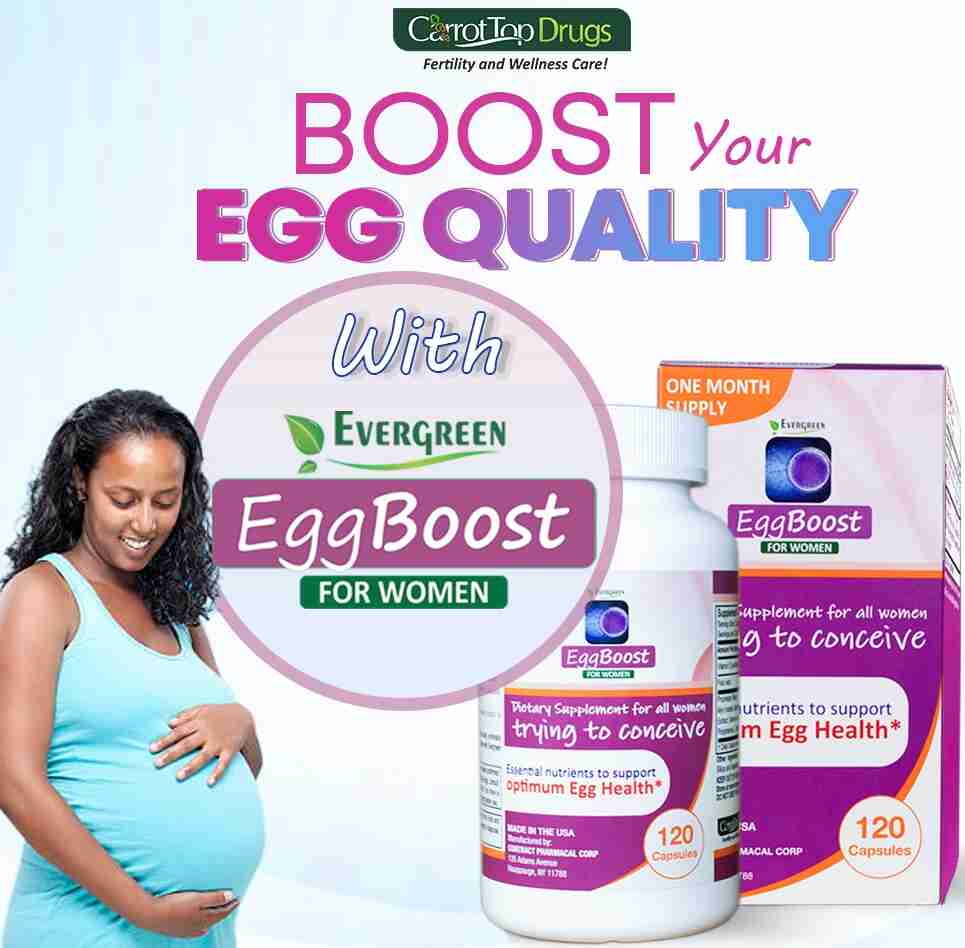
Supplements support. They do not diagnose, and they cannot unblock a tube. For egg health, Evergreen EggBoost for Women lists coenzyme Q10 and myo-inositol and it is recommended to take it together with Evergreen Formula for Women. Keep one thing in mind: AMH measures how many eggs remain, not their quality, so a supplement aimed at egg quality will not show up as a higher AMH. Judge it by your doctor’s overall assessment and by time.
Before you buy any fertility supplement:
- Show your results to a doctor or pharmacist.
- Check the NAFDAC registration number on the pack.
- Buy from a licensed pharmacy. Cochrane notes that most antioxidant supplements are not tightly regulated.
- Tell your doctor about any other medication you take.
Your next steps
- Complete the workup. Women: AMH, day 2 to 4 FSH and estradiol, a well-timed progesterone, a pelvic scan and an HSG. Men: a semen analysis, repeated if abnormal.
- See a specialist if anything is borderline, a reproductive endocrinologist for the woman and a urologist or andrologist for the man.
- Treat what can be treated: thyroid or prolactin problems, infections, weight, alcohol and smoking.
- Repeat the tests that need repeating, usually after about three months.
- Decide on treatment together once both pictures are clear.
If your results point to an area where nutritional support may help, you can look at Evergreen Formula for Women, Evergreen EggBoost for Women and Evergreen Formula for Men at Carrot Top Drugs. Bring your lab report when you ask questions, so the advice you get matches your numbers.
Understanding your fertility test results is the first step. The second is acting on them while time is on your side.
FAQs
What is a normal AMH level for getting pregnant?
ASRM treats 1.0 to 3.5 ng/mL as the normal range. Under 1 ng/mL is low, yet pregnancy remains possible, and age matters as much as the number.
Can a woman with low AMH still conceive naturally?
Yes. In the ASRM review, women with low AMH had pregnancy rates similar to women with normal values. A low result is a reason to move sooner, not to give up.
Which cycle day should I do each test?
Day 2 to 4 for FSH and estradiol. About a week before your expected period for progesterone. AMH can be done on any day, per ASRM.
Why does the man need testing when my results are normal?
Because a male factor is involved in roughly half of infertility cases, alone or together with a female factor. Testing only the woman can cost months.
Is one abnormal semen analysis enough for a diagnosis?
No. The AUA/ASRM guideline notes that one value outside the reference limit does not by itself predict infertility. Repeat the test, and use a lab that processes samples quickly.
Can supplements fix poor fertility test results?
They may help in some areas, such as sperm quality, but the evidence is low to very low certainty for men and thinner for women. They cannot replace treatment for blocked tubes, ovulation disorders or severe sperm problems.
How common are blocked tubes in Nigerian women with infertility?
Common enough that an HSG is a standard test. One Nigerian study found tubal problems in 35.1% of abnormal HSG results, and an older series found 51.1%.
When should I see a doctor about my results?
Immediately if anything is flagged. If everything looks normal and you have not conceived after a year (six months if the woman is 35 or older), the CDC advises seeing a provider.