Introduction
How long does it take for fertility supplements to work is one of the first questions women ask after they open their first bottle. The answer sits in biology, not marketing.
Most people expect results within weeks. The truth is harder to hear but far more useful. Fertility supplements work on a biological clock that is measured in months, not days.
According to Science Insights, most fertility supplements need at least two to three months to make a meaningful difference. This timeline is not arbitrary. It maps directly onto how your body develops eggs and sperm.
This article explains exactly why that timeline exists, what happens inside your body during each month of supplementation, how long specific supplements take to show results, and what factors speed up or slow down your progress.
The Biology Behind the 90-Day Timeline
To understand when fertility supplements start working, you first need to understand how eggs and sperm develop.
Eggs do not mature overnight. Each egg goes through a development process that takes roughly 90 days before it reaches ovulation. During this window, the egg is drawing on cellular energy, antioxidant protection, and hormonal signals to mature correctly.
As Bird and Be explains, supplements can only support cells that are currently in development. The nutrients you take today are building the quality of eggs that will be available two to three months from now.
Sperm follow a similar timeline. Sperm take roughly 74 days to develop from stem cell to maturity, with a further 10 to 14 days of final maturation before they are ready for fertilization.
This is why Science Insights states that sperm-targeted supplements need a minimum of 74 days to affect the current crop of developing sperm. Any semen analysis done before this window closes gives an incomplete picture.
The 90-day rule is not a guideline from supplement companies. It is a reflection of the reproductive biology that governs every human body.
Month by Month: What Actually Happens
Understanding the month-by-month progression helps you stay consistent rather than quitting too early because you do not feel anything happening.
Month One: Building the Foundation
During the first month, your body absorbs the nutrients and begins distributing them to reproductive tissues. Blood levels of key vitamins and minerals start to rise.
You may notice improved energy, better sleep, or a more regular menstrual cycle. These early changes come from nutrients like B vitamins, magnesium, and zinc acting on your general hormonal health. Reproductive cell changes have not yet had enough time to develop.
This is also when many women give up. Nothing visible has happened, and impatience sets in. Month one is the time to stay the course, not reassess.
Month Two: Cellular Activity Picks Up
By month two, antioxidant nutrients like vitamin E, grape seed extract, and selenium are actively reducing oxidative stress in follicular fluid. This is the environment inside which your eggs develop.
CoQ10 begins accumulating in follicular tissue. Myo-inositol starts influencing insulin signaling in the ovaries. Folic acid supports healthy DNA replication in developing cells. None of these changes are visible to you yet, but they are measurable at the cellular level.
Research cited by Superpower confirms that CoQ10 requires 60 to 90 days of supplementation to reach steady-state tissue levels. Before that point, cellular concentrations are still building.
Month Three and Beyond: Cellular Changes Become Measurable
Month three is when fertility vitamins start working at the level that matters most. The eggs that began development at the start of your supplement routine are now approaching ovulation. They have had the full benefit of three months of nutritional support.
Clinical research reviewed by Life Science Daily shows that CoQ10 takes at least 60 days to influence oocyte quality, in line with the follicular development timeline. This means measurable egg quality improvements show up at or after the three-month mark.
For men, sperm produced during this window reflects the nutritional environment of the past 74 to 90 days. A semen analysis at the three-month mark gives a far more accurate picture of supplement impact than one taken at six weeks.
Most studies on fertility supplements run for exactly three months for this reason. It is the minimum window needed to capture true reproductive impact.
How Long Do Specific Fertility Supplements Take to Work?
Different nutrients act on different systems and at different speeds. Here is what the research shows for each major supplement category.
Folic Acid and Folate
Folic acid begins protecting against neural tube defects from the moment blood levels rise, which happens within days of starting supplementation. This is why starting before conception matters so much.
However, folate’s role in egg development operates on the longer 90-day timeline. Women with the MTHFR gene variant benefit more from methylfolate, which the body uses directly without a conversion step.
Myo-Inositol
Studies using myo-inositol for PCOS typically run for three months and report measurable improvements in ovulation frequency, cycle regularity, and egg quality at that point.
A double-blind randomized controlled trial cited in PMC found that men taking myo-inositol with folic acid for three months showed significant improvements in sperm concentration, motility, and acrosome reaction. The same three-month window applies on the female side.
Women with PCOS often notice improved cycle regularity within six to eight weeks. Full egg quality benefits take the complete 90 days.
CoQ10
CoQ10 is one of the most studied fertility nutrients. Superpower reports that meta-analyses of randomized trials show CoQ10 supplementation in men with idiopathic infertility improves sperm concentration, motility, and morphology. Effect sizes for motility range from 10 to 20 percentage points over placebo.
For women, CoQ10 accumulates in follicular fluid after supplementation and correlates with improved oocyte quality. The effect is most pronounced in women over 35, where mitochondrial function declines naturally with age.
Timeline: 60 to 90 days for measurable cellular impact. Give it the full three months before assessing results.
Vitamin D
Vitamin D levels rise within four to six weeks of supplementation. However, if your baseline is severely deficient, correcting it fully can take three to six months.
Get a blood test before starting vitamin D. This tells you exactly how much you need and gives you a benchmark to check progress against at three months.
Zinc and Selenium
Both zinc and selenium support sperm DNA integrity and protect developing oocytes from oxidative damage. Their tissue levels stabilize within four to six weeks of consistent daily use.
However, their reproductive impact operates on the full spermatogenesis and folliculogenesis timeline. Do not assess results before the 90-day mark.
Factors That Affect How Quickly Fertility Supplements Work
Several individual factors influence how fast you see results from fertility supplementation. Two people taking identical supplements on the same schedule can experience different timelines.
- Baseline nutritional status: Women with severe deficiencies take longer to see results because supplements must correct the deficit before building a surplus. A blood panel before starting tells you where you stand.
- Age: Older eggs have greater mitochondrial dysfunction to overcome. Women over 38 may need five to six months of supplementation before seeing the full benefit, particularly with CoQ10.
- Consistency: Missing doses breaks the supply of nutrients to developing cells at critical points. The 90-day timeline only holds if supplementation is daily and uninterrupted.
- Underlying diagnosis: Women with PCOS or thyroid disorders may see earlier improvements in cycle regularity but still need the full 90 days for egg quality changes. Women with unexplained infertility often respond well to comprehensive micronutrient support.
- Diet and lifestyle: Supplements fill gaps in nutrition. A diet high in processed foods, alcohol, or refined sugar creates more gaps than supplements can easily close. Pair supplementation with dietary improvements for faster and deeper results.
- Absorption: Fat-soluble vitamins like D, E, and CoQ10 absorb better when taken with a meal containing healthy fats. Poor absorption slows the timeline.
Signs That Your Fertility Supplements Are Working
Because egg and sperm quality changes happen at the cellular level, you cannot feel them directly. However, several observable signs indicate your supplements are having an effect.
- More regular menstrual cycles. Women who previously had irregular cycles often notice improved regularity by month two.
- Reduced period pain. Anti-inflammatory nutrients like vitamin E, omega-3, and magnesium often reduce dysmenorrhea within six to eight weeks.
- Improved cervical mucus quality. Better egg white consistency in the days around ovulation suggests improved hormonal signaling.
- Increased energy around ovulation. This can reflect improved mitochondrial function from CoQ10 and B vitamins.
- Better ovulation tracking results. Women using basal body temperature or LH strips may notice a clearer, more defined ovulation pattern.
For men, a follow-up semen analysis at the three-month mark is the most objective way to measure progress. This is far more reliable than waiting to see if conception occurs.
What to Do If Your Supplements Are Not Working After Three Months
If you have taken fertility supplements consistently for 90 days and have not conceived or noticed any positive changes, this is important information rather than a reason to panic.
First, rule out the obvious causes. Were you consistent every day? Did you take fat-soluble supplements with food? Did you start the supplements while also addressing diet, sleep, and alcohol consumption?
If the answer to all of these is yes, the next step is a medical evaluation. Supplements support fertility. They do not treat structural issues like blocked tubes, fibroids, or severe hormonal disorders. These require clinical intervention alongside nutritional support.
As Pacific NW Fertility notes, fertility supplements have a role in select patient groups. They work best when chosen to match a specific diagnosis and used alongside appropriate medical care.
Visit the office of Carrot Top Drugs if you need guidance on whether your current supplement plan matches your fertility profile. The team can help you identify gaps and point you toward the right specialist if needed.
Evergreen Eggboost and Evergreen Formula for Women: Built for the 90-Day Window
Both Evergreen fertility supplements are formulated with the 90-day biological timeline in mind. Their ingredients target the specific cellular processes that determine egg quality and reproductive hormone balance.
Evergreen Eggboost
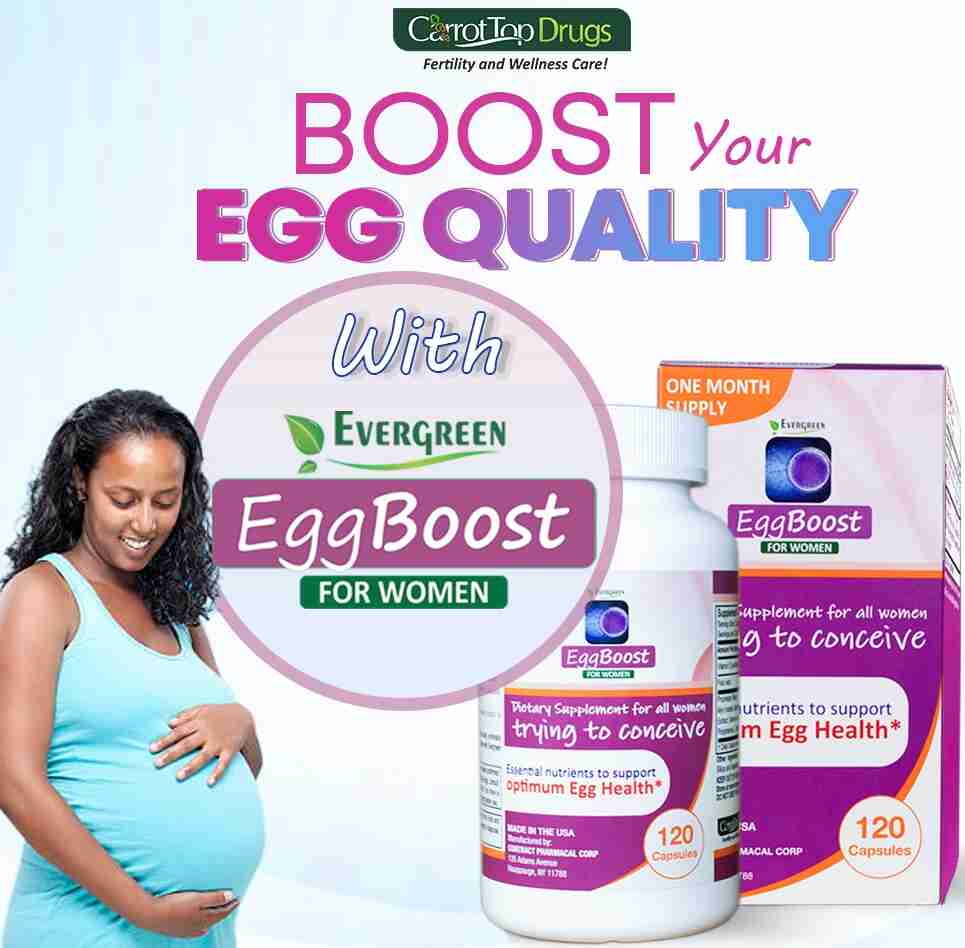
Evergreen Eggboost promotes oocyte quality and supports healthy ovarian function in women actively trying to conceive.
Key ingredients: Myo-Inositol, Folic Acid, Melatonin, Vitamin E, Grape Seed Extract.
Myo-Inositol begins improving insulin signaling and ovulation patterns within six to eight weeks. Melatonin reduces oxidative damage in follicular fluid throughout the full 90-day development cycle. Vitamin E and Grape Seed Extract protect developing oocytes from free radical damage at every stage.
Start Evergreen Eggboost three months before you begin trying to conceive. This ensures the eggs that reach ovulation during your active conception window have had the full benefit of every ingredient.
Evergreen Formula for Women
Evergreen Formula for Women is a fertility adjuvant for the dietary management of idiopathic infertility in women.
Key ingredients: Vitamins A, C, D3, E, B1, B2, B3, B6, Folic Acid, B12, Pantothenic Acid, Iron, Iodine, Magnesium, Zinc, Selenium, Copper.
Evergreen Formula for Women fills the complete micronutrient picture that egg development, hormonal signaling, and uterine preparation all depend on. Zinc and selenium protect reproductive cells from oxidative stress. Magnesium and B vitamins support the hormonal axis. Iron and iodine underpin thyroid and ovulatory function.
For women with unexplained infertility, this formula addresses the full range of potential micronutrient gaps that standard testing often misses. Use it alongside Evergreen Eggboost for a complete preconception strategy covering the entire 90-day window.
Both supplements are available at the office of Carrot Top Drugs. The team can advise you on when to start and how to structure your preconception supplement plan around your specific timeline.
Frequently Asked Questions
How long does it take for fertility supplements to work?
Most fertility supplements take at least three months to produce measurable reproductive changes. This maps onto the 90-day maturation cycle of eggs and the 74 to 90-day spermatogenesis cycle for sperm. Consistency throughout the full three months is essential.
Will I feel anything in the first month of taking fertility supplements?
You may notice improved energy, better sleep, or more regular cycles within the first month. These reflect the general hormonal and metabolic effects of B vitamins, magnesium, and zinc. Reproductive cell changes take longer and are not directly felt.
Can fertility supplements speed up conception?
They improve the quality of the eggs and sperm available for fertilization, which improves the monthly chance of conception. They do not compress the biological timelines of egg or sperm development. Starting earlier gives them more time to build their effect.
How long does myo-inositol take to work for PCOS?
Women with PCOS often notice improved cycle regularity within six to eight weeks of taking myo-inositol. Full benefits to egg quality take the complete 90-day follicular development window. Most studies confirm measurable improvements at the three-month mark.
How long does CoQ10 take to improve egg quality?
CoQ10 requires 60 to 90 days to reach steady-state tissue levels in follicular fluid. This is the minimum time needed to see measurable egg quality improvements. Women over 35 benefit most, but the 90-day timeline applies regardless of age.
Should my husband also take fertility supplements?
Yes. Male factors contribute to a significant share of fertility challenges. Sperm quality supplements need 74 to 90 days to affect the current sperm development cycle. Both partners benefit from starting supplementation at the same time, three months before active conception attempts.
What if I do not see results after three months?
Rule out inconsistent use first. If supplementation has been daily and paired with healthy lifestyle habits, seek a medical evaluation. Supplements support fertility but cannot treat structural issues or severe hormonal disorders. A fertility specialist can identify whether additional intervention is needed.
Where can I get fertility supplements in Nigeria?
The office of Carrot Top Drugs carries Evergreen Eggboost and Evergreen Formula for Women. The team can guide you on the right combination for your situation and advise you on when to start relative to your conception timeline.
Final Thoughts
How long does it take for fertility supplements to work? The honest answer is three months at the minimum. That timeline is not a marketing strategy. It is the length of a single reproductive cell cycle.
Start three months before you plan to try to conceive. Take your supplements every day without gaps. Pair them with a diet that supports rather than undermines your nutritional plan. And give the process the time it genuinely needs.
Evergreen Eggboost and Evergreen Formula for Women are built around this 90-day window. Together, they cover egg quality, hormonal balance, and full micronutrient support across the complete preconception timeline. Visit the office of Carrot Top Drugs to begin your plan today.