Introduction
Do you know how to calculate your ovulation day? That is the big question! You have been trying. Every month feels like a waiting game you cannot win.
The truth is, timing is everything. Most couples trying to conceive do not realise that the fertile window is only five to six days long per cycle. Miss it, and you wait another month entirely.
Knowing how to calculate your ovulation day and get pregnant is not complicated biology reserved for doctors. It is practical, learnable knowledge that can change everything for you.
This guide gives you the full picture. The science, the methods, the signs, and the tool that removes all the guesswork. Let us get into it.
What Is Ovulation and Why Does It Matter?
Ovulation is the release of a mature egg from one of your ovaries. It happens once per cycle. That egg survives for only 12 to 24 hours after release.
Sperm, however, can survive inside the female reproductive tract for up to five days. This creates your fertile window. It opens a few days before ovulation and closes shortly after.
Missing this window means fertilisation cannot occur that cycle. A 2019 study in Human Reproduction confirmed that timing intercourse to the fertile window is the single most important factor in natural conception.
This is why learning to calculate your ovulation day and get pregnant faster is not optional. It is the foundation of your entire conception strategy.
Understanding Your Menstrual Cycle
Your cycle has four phases. Each one builds toward the moment of ovulation.
Phase 1: Menstruation
This is day one of your cycle. Bleeding occurs as the uterine lining sheds. It typically lasts three to seven days.
Phase 2: Follicular Phase
Follicle-stimulating hormone (FSH) rises. Your ovaries begin developing follicles. One dominant follicle grows and produces oestrogen.
Rising oestrogen thickens the uterine lining. It also prepares the body for the LH surge that triggers ovulation.
Phase 3: Ovulation
A spike in luteinising hormone (LH) causes the dominant follicle to rupture. The egg is released. This is the moment your entire fertile window centres around.
LH surges typically precede ovulation by 24 to 36 hours. Research published in Fertility and Sterility confirms this LH surge window is highly consistent across women with regular cycles.
Phase 4: Luteal Phase
After ovulation, the follicle becomes the corpus luteum. It produces progesterone to support potential implantation.
This phase is remarkably consistent at 12 to 14 days. Cycle length varies mostly in the follicular phase, not the luteal phase.
How to Calculate Your Ovulation Day
There are several ways to work this out. Some are rough estimates. Others are precise. Using more than one method together gives you the best result.
Method 1: The Calendar Method
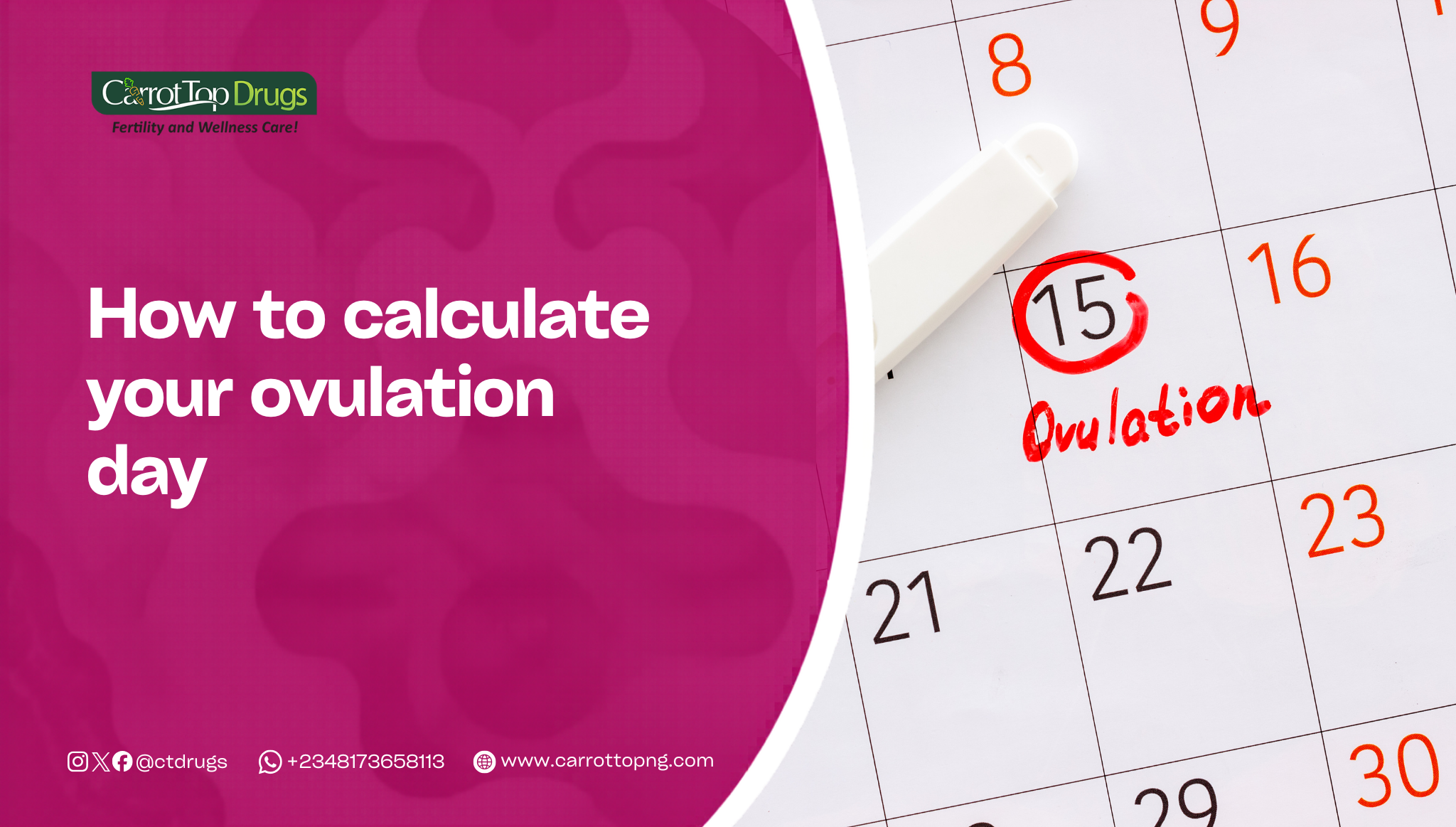
Subtract 14 days from the expected start of your next period. This gives an approximate ovulation date.
For a 28-day cycle, ovulation likely falls around day 14. For a 32-day cycle, it falls closer to day 18.
The calendar method is imprecise for irregular cycles. A 2020 study found that fewer than 30% of women have a cycle that fits the textbook 28-day model. Use it as a starting point, not a definitive answer.
Method 2: Basal Body Temperature (BBT) Tracking
Your resting temperature rises slightly after ovulation. The rise is small, typically 0.2 to 0.5 degrees Celsius.
You measure your temperature every morning before getting up. Chart it daily over several months. A pattern emerges.
The limitation is timing. BBT confirms ovulation has already happened. It cannot reliably predict when it will happen next.
Method 3: Cervical Mucus Observation
As ovulation approaches, cervical mucus changes dramatically. It becomes clear, slippery, and stretchy, like raw egg white.
This egg-white cervical mucus is the most fertile sign your body produces. Research in the European Journal of Obstetrics confirms that egg-white mucus is strongly correlated with the fertile window.
After ovulation, mucus becomes thick, cloudy, and scanty. Learning to read these changes takes two to three cycles of consistent observation.
Method 4: LH Surge Detection (The Most Accurate Home Method)
This is where things get precise. LH spikes in the bloodstream 24 to 36 hours before an egg is released.
Ovulation predictor kits (OPKs) detect this surge in urine. A positive result means you are in your peak fertile window. Right now.
OPKs are significantly more accurate than calendar or BBT methods alone. A 2022 clinical review found that LH-based detection is the gold standard for home ovulation prediction.
This is the method most fertility specialists recommend for couples actively trying to conceive.
Your Fertile Window Explained
The fertile window spans roughly six days. It includes the five days before ovulation and the day of ovulation itself.
The two to three days immediately before ovulation carry the highest probability of conception. Sperm need time to travel and wait for the egg.
Timing sex on the day of the LH surge and the following day gives you the best statistical odds. A landmark study in the New England Journal of Medicine mapped day-by-day conception probabilities across the fertile window. Peak probability sits at 33% on the day before ovulation.
Daily or every-other-day sex during this window maximises your chances without reducing sperm quality. Every day is sustainable; every other day is equally effective.
Signs You Are About to Ovulate
Your body gives you signals. Learning to read them is part of understanding how to calculate your ovulation day and get pregnant more confidently.
- Egg-white cervical mucus that is clear and stretchy.
- Mild pelvic cramping or twinges on one side (mittelschmerz).
- A slight dip then rise in basal body temperature.
- Increased libido, which is not coincidental but biologically programmed.
- Breast tenderness or mild bloating.
- Heightened sense of smell or taste.
No single sign is definitive. The combination of physical symptoms plus LH detection gives you the most complete picture.
The Tool That Takes the Guesswork Out Completely
Reading body signs takes practice and time. A lot can still go wrong when you rely on observation alone.
This is exactly why the Predicte Digital Ovulation Test exists.
Predicte Digital Ovulation Test is a urine-based ovulation predictor kit you use at home. It detects the rise of LH in your urine, 24 to 36 hours before ovulation occurs. No interpretation needed. No squinting at faint lines.
The result window displays a clear YES when your LH surge is detected. That single word means your most fertile days are right now. It does not get more straightforward than that.
Why Digital Beats Traditional Line Tests
Traditional OPK strips require you to compare line darkness, which introduces significant subjectivity. A 2021 study found that digital OPKs reduced user misinterpretation by over 50% compared to standard line-based tests.
With Predicte, the device reads the result for you. One word. No second-guessing. No, holding the strip up to different lights, trying to decide if the line is dark enough.
What Predicte Digital Ovulation Test Delivers
- Detects the LH surge 24 to 36 hours before ovulation occurs.
- Identifies your most fertile days clearly within any given cycle.
- Displays an unmistakable YES result on a digital screen when your surge is detected.
- Easy to use at home with no lab equipment or clinical training required.
- Gives you the information you need to time intercourse for maximum conception odds.
Get Predicte Digital Ovulation Test here: Predicte Digital Ovulation Test on CarrotTop.
When to Start Testing Each Cycle
Start testing a few days before you expect to ovulate. For a 28-day cycle, begin around day 10. For a 32-day cycle, start around day 14.
Test once daily, preferably in the afternoon between 10 AM and 8 PM. LH builds in the blood first, then spills into urine a few hours later.
Do not test first thing in the morning. It dilutes the LH concentration and can cause a false negative early in your surge.
Afternoon testing consistently yields better LH detection accuracy. This 2019 timing study confirmed afternoon samples outperformed morning samples in surge detection sensitivity.
Once you see a YES result, have sex that day and the following day. Those 48 hours represent your highest probability window.
Common Mistakes That Cost You a Cycle
Testing Too Late in the Day
Evening testing can still detect a surge, but you may catch it late. Afternoon remains the optimal window for LH in urine.
Waiting for Ovulation Symptoms Before Testing
Symptoms come after or during ovulation. By then, the window is already closing. Testing must begin before you feel anything.
Only Having Sex on the Day of the Positive Test
The LH surge predicts ovulation 24 to 36 hours out. Having sex only on the positive day may already be slightly late. Start when you see the YES, then continue the next day.
Irregular Cycles and Fixed Testing Schedules
If your cycle varies significantly month to month, rigid testing schedules will miss your surge. Test for a longer window, starting earlier and continuing until you detect the surge.
Women with irregular cycles have higher rates of missed fertile windows when using calendar-only methods. A 2020 analysis confirmed OPK testing is more reliable than calendar calculation for women with variable cycle lengths.
How Long Does It Usually Take to Get Pregnant?
This is the question underneath every other question on this topic. The honest answer is: it varies.
Among couples having regular unprotected sex, about 84% conceive within one year. Data from a large cohort study published in Human Reproduction Update confirms this figure across age groups under 35.
With proper ovulation tracking, many couples significantly reduce time to conception. Knowing your fertile window is the single most modifiable variable in natural conception.
Age matters, but it is not the only factor. Cycle health, ovulation regularity, and timing accuracy all contribute significantly.
Women who accurately identify and act on their fertile window conceive faster on average. A 2018 prospective cohort confirmed that OPK users had shorter time to conception compared to couples using calendar methods alone.
When to See a Doctor
Tracking and timing are powerful tools. But they are not a substitute for medical evaluation when something is wrong.
Consider seeing a doctor if you have been trying for 12 months without success if you are under 35. Seek help after six months if you are 35 or older.
- Cycles shorter than 21 days or longer than 35 days.
- No detectable LH surge across three or more consecutive cycles of testing.
- Irregular or absent periods.
- A history of pelvic inflammatory disease, endometriosis, or PCOS.
- Known male factor concerns.
Early evaluation is not admitting defeat. It is a smart use of your time during a period when time genuinely matters.
Start With What You Can Control Today
You cannot control everything about conception. But you can control your timing. And timing is everything.
Learning how to calculate your ovulation day and get pregnant starts with one reliable tool. You do not need a clinic, a prescription, or a complicated protocol.
You need to know when your LH surge happens. Predicte Digital Ovulation Test tells you exactly that. Clearly. Simply. At home.
If you are serious about getting pregnant this cycle, start here: Predicte Digital Ovulation Test. The YES you see on that screen could be the beginning of everything you have been working toward.